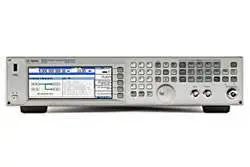
Description
Additional Features:
- Performance optimized for manufacturing
- Fast switching speeds
- Simplified self-maintenance
Signal characteristics
- 100 kHz to 3 or 6 GHz
- >+23 dBm up to 3 GHz using a highly-reliable, fast-switching electronic attenuator
- W-CDMA dynamic range: ≤-73 dBc at +5 dBm output power
- ≤900 μs simultaneous frequency, amplitude, and waveform switching in list mode
Modulation and sweep
- AM, FM, øM, and pulse
- ASK, FSK, MSK, PSK, QAM
- Digital step and list sweep with simultaneous switching of frequency, power, and waveform
Baseband generation and signal creation
- 100 MHz internal I/Q baseband generator with real-time equalization for excellent EVM performance
- Up to 64 MSa playback memory and 800 MSa storage
- Create reference signals: LTE, HSPA+, WiMAX™, WLAN, DVB-H, DAB, MATLAB and more – Signal Creation
- Multi-channel Baseband generation, Digital I/O, MIMO Fading and RF to RF fading with N5106A PXB baseband generator and channel emulator
Automation and communication interface
- 100BaseT LAN, LXI class-B, USB 2.0, and GPIB
- SCPI and IVI-COM drivers
- Backwards compatible with all ESG, PSG, 8648 signal generators, and other vendors´ signal generators
The Agilent N5182A features fast frequency, amplitude, and waveform switching, high power with an electronic attenuator, and high reliability – all in two rack units (2RU). The Agilent MXG vector is optimized for manufacturing cellular communications and wireless connectivity components. Agilent MXG vector provides better value for your investment by increasing throughput, improving test yield, maximizing uptime, and saving rack space. With scalable RF and baseband performance, the Agilent MXG vector is easily configured to meet your specific test needs.
Best-in-class RF performance for tomorrow’s component design
With the industry’s best combination of high power and distortion performance MXG vector signal generators ensure accurate component design verification. When combined with flexible signal creation tools such as Signal Studio software, the low ACLR (-73 dBc at +5 dBm for 1 carrier W-CDMA) makes the MXG a complete solution for W-CDMA, WiMAX™, and more.
Maximize uptime
Simplified self-maintenance decreases time for repair and performance verification, keeping downtime to less than 2 hours using field-replaceable assemblies.
Explore more from our collection.


Reviews
There are no reviews yet.